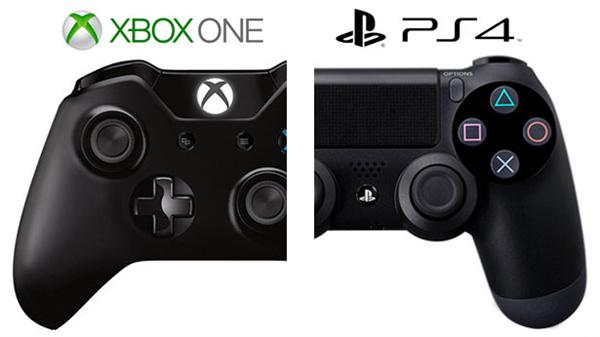
The battle between Sony’s PlayStation 4 and Microsoft’s Xbox One has been going on for some time now. It will take some time before actual sales for the initial selling season are announced. It may even be 2014 before we find out the console that is actually winning the competition for next generation consoles. Thanks to IHS, the market research firm, we have an idea of how much each console costs to manufacture. This in turn gives a lot of information on how the console competition will be unfolding in the years to come. A cost analysis will tell us a lot more on the choices that both console designers from each company had to make, and how the same will affect the competition in the coming years.
The Xbox One from Microsoft costs approximately $471 to manufacture while PlayStation 4 cost $381. This naturally explains why Sony is selling its console at $400 while Microsoft is selling Xbox One for about $500. An approximate $75 spent on the Xbox One is mainly covering the Kinect motion-sensing camera (second generation). Microsoft says that it believes the technology of this camera is the future for not only gaming consoles, but also for television, as one can use it to flip through channels as they watch television. Sony sells the PlayStation Camera separately as an option. It goes for $60 and since it is an option, Sony does not seem to have a similar confidence in its peripherals as Microsoft has.
The difference in pricing is going to provide Sony with a cost benefit that will last for years to come. To make up for the same, Microsoft will have to ensure it sells a lot more games than its competitor. The sad thing about this is that in the near future, Sony will have a higher chance of looking better in terms of its games. This is attributed to the simple fact that the company invested a bigger percentage of the company’s hardware dollars into the creation of a system that has a higher graphics performance than that of Microsoft. The use of Kinect in each base system for Xbox One is the only way Microsoft can possibly have a shot at gaining technical superiority over Sony. However, it is not a bet that one should make when they take into consideration the kind of lackluster love gamers are currently showing for motion sensing games.
Secondly, even though Sony is better with graphics performance, the processor Microsoft uses from AMD (Advanced Micro Devices) costs about $110 which is $10 more than Sony’s AMD processor. While Microsoft preferred to use a cheaper and old memory system, Sony opted to deliberately spend more on of its budget on graphics memory chips. Architect of PlayStation 4, Mark Cerny, had explained earlier this year that Sony made the move with the intent of simplicity. Because he was aware that PS3 was too complex to design games of, Cerny came up with a system that was not only easy to program games for, but also to understand.
It would be interesting to watch the outcome. Any time that Microsoft makes a decision to reduce the price of its console, Sony will be capable of reacting by doing the same. In this generation, that gives Sony many competitive advantages. Sony, if it chooses, has a chance of being the price leader as was evident at the outset. Instead, it could also opt to be the leader in profit. Nomura Securities analyst, Rick Sherlund, estimates that $1 billion will be lost by Microsoft on its console this year. Although it is a loss leader, it is not very different from history.
In 2006, iSuppli (acquired by IHS) discovered that the PS3 with a 60GB harddrive cost Sony about $840 to manufacture. That was the reason the company priced the primary machine at $600 which was untenable. By comparison, the Xbox 360 Premium was launched by Microsoft at $399. Initially the machine cost Microsoft $525 to design.
In those days, console manufacturers viewed their machines as loss leaders. They then embraced the razor blades and razor models, where they lost money on consoles and made money on $60 games that they sold together with their partners. All the same, Microsoft had a huge advantage on Sony, because it had lower production costs and Sony did not have so much of an advantage. This was because it took too long for developers to understand how they could make games that could comfortably run on the eight-core Cell microprocessor used by Sony. In that entire generation, Sony never really got a realistic competitive advantage on Microsoft. That generation was always operating at profit or unit disadvantage to Sony.
In 2001, when the first generation of Microsoft’s Xbox was launched, the company sold its console for $300 during the outset, despite the cost for manufacturing being $425. That was a very deep hole since Microsoft lost billions of dollars over 4 years. That particular machine was outsold by PlayStation 2 by six to one. Although Microsoft could afford it, this led to huge losses. The move accomplished the strategy to get Microsoft into the console business. A lesson to be learnt with the numbers is that it can be quite difficult to get yourself out of a big hole. It is quite hard to catch up to your rival when you start out with a cost disadvantage.
On one hand, the whole point of creating a more expensive console is to gain an advantage that is technological based. If the bet Microsoft made on Kinect’s Version 2 is a viable one, then the company will have something that gives it an edge over Sony by enticing gamers for years to come.
Cost matters at times. At the outset in the present generation, neither company is willing to sell a console for a price that is below the cost price. In the long run will this cost both companies? It simply means that the PC gamer will outrun console sooner than it might have been expected. It also means that the machines may fail to ‘wow’ gamers to the level they should.
All the same, neither company risks being pushed out of business as a result of the upfront losses that are associated with each console, which is very important. The numbers from IHS tell us a lot of information regarding the choices made by each company, and there are many trade-offs in the current generation.