“If you’re in desperate need of a supercomputer that you need to fit under your desk, we have just the card for you…” Earlier today, NVidia announced a brand new video card that surpasses their current GTX Titan. During their annual GPU Technology Conference, CEO Jen-Hsun Huang revealed the GeForce GTX Titan Z. a severely expensive GPU that is “engineered for next-generation 5K and multi-monitor gaming”.
The Titan Z is NVidia’s new dual-processor video card, equipped with 12GB of on-board RAM and two Kepler GPUs with 2,880 cores each. Essentially, this is two Titans that have been fused together via technology and witchcraft. In the case of other dual-GPU cards, one or both processors have been overclocked (pushing the processor-speed faster than the factory recommendation); both GPUs within the Titan Z will run at the same speed to avoid “bottlenecking”:
Unlike traditional dual-GPU cards, Titan Z’s twin GPUs are tuned to run at the same clock speed, and with dynamic power balancing. So neither GPU creates a performance bottleneck. And that performance is delivered in a card that is cool and quiet, rather than hot and loud. Low-profile components and ducted baseplate channels minimize turbulence and improves acoustic quality.
While it isn’t stated in the official release on NVidia’s blog, the hardware developer confirmed with Polygon that the GeForce GTX Titan Z will have a price tag of $2,999.

The new GeForce GTX Titan Z. (Image courtesy of NVidia)
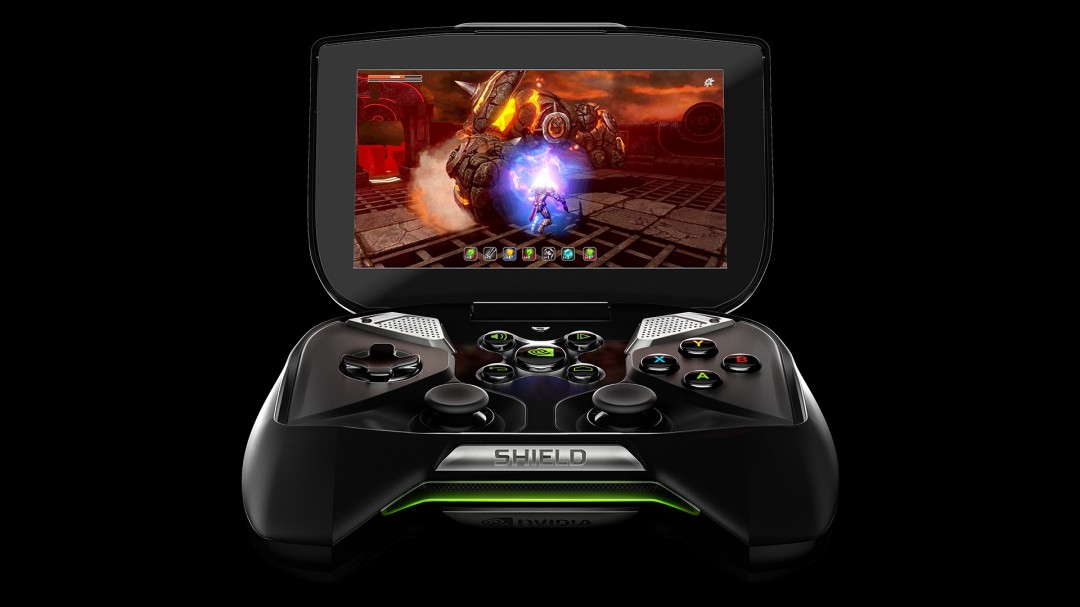
Along with the new video card that’s equipped with the power of the gods, NVidia announced that a new update will be coming to the NVidia Shield on April 2. Beginning on April 2, the internal GameStream service will have an added beta feature, allowing users to stream games from their PC to their Shield when they aren’t at home. The feature would allow users to log in to a PC that’s either active or in Sleep Mode, and play games through a mobile hotspot; according to Polygon, the service could potentially be used through a smartphone’s 4G LTE connection. However, streaming will require a minimum Wi-Fi bandwidth of 5mb per sec. The new update also allows Shield owners to stream games from GeForce GTX 800M equipped notebooks and laptops. Along with video games, the improved GameStream can stream standard software apps.
While the NVidia Shield can be used as a home console PC (i.e. it can be hooked into a TV), users still needed to use a controller for gaming; the April update will add support for Bluetooth-enabled mice and keyboards for use within “Console Mode”.
A representative from NVidia stated that the Shield has been running on “stock Android”; the internal OS will upgrade to Android 4.2.2 KitKat in April. To help make the Shield “more attractive to potential customers”, the device has been dropped $50, from $249 to $199. The sale will remain until the end of April.
The last bit of news from NVidia, Valve’s first-person-puzzle game, the original Portal is currently in-development as a Shield title. Valve’s Doug Lombardi states that NVidia’s Shield system is a “very powerful and unique device”, and their companies “have a strong history working together”. The critically acclaimed Portal will be coming to the Shield sometime “soon”.