KASTEN’s debut hides its answers outside the software, and the idea works. At 4.99 dollars, the only real question is how much game is attached to it.
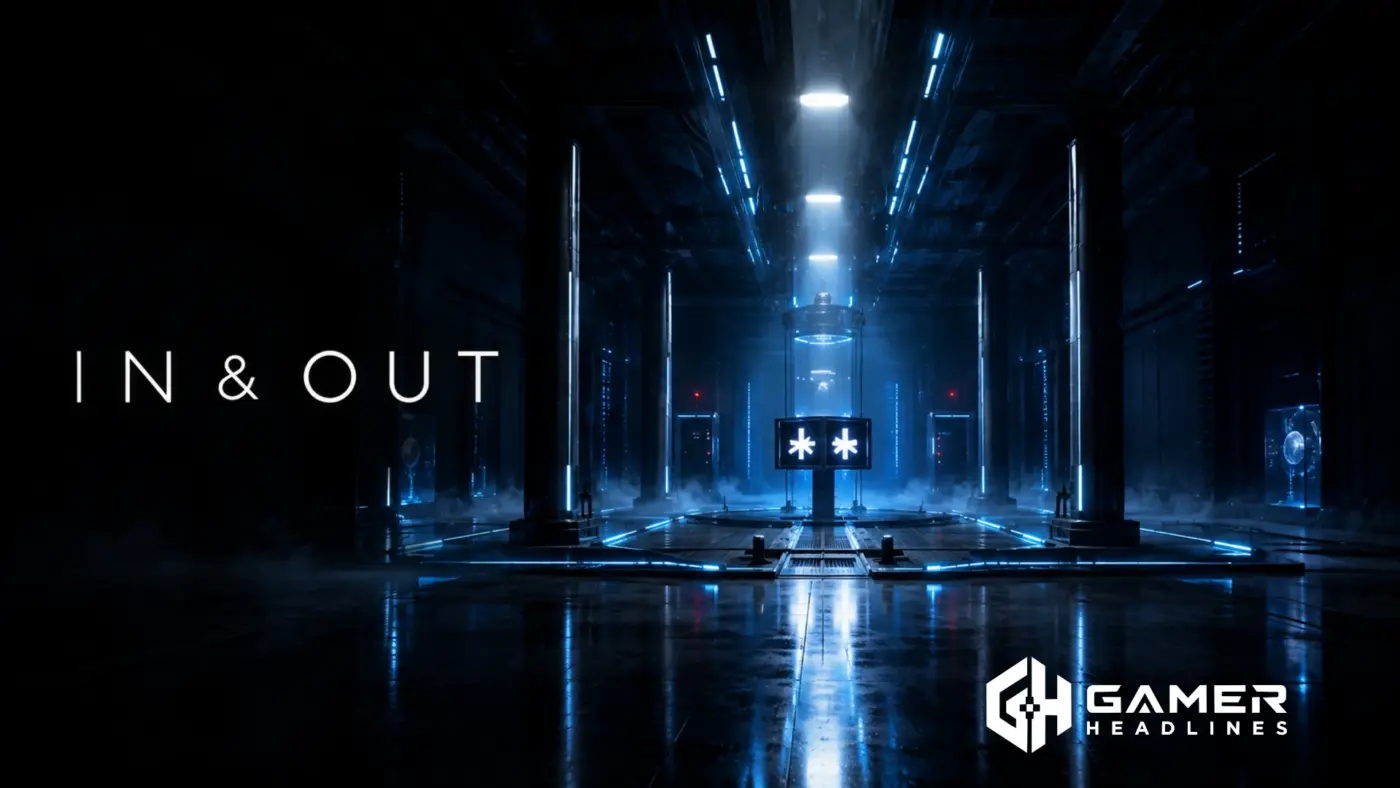
You wake in one room. Three elevators, numbered 10, 12 and 14. A terminal on a plinth in the middle of the floor. Nobody explains anything, because there is no voice, no tutorial and no quest marker anywhere in IN & OUT. The terminal shows you a symbol, and the symbol means nothing until you go and find out what it is.
That is the whole design, and the title is the instruction. The IN is everything the facility holds, meaning its rooms, screens, mechanisms and glyphs. The OUT is whatever you can drag back from the real world. KASTEN, an independent French studio making its first game, names the loop in four steps: Observe, Research, Understand, Decide. Only the first and last happen on screen. The middle two happen in a browser tab, a reference book, or a message to the one friend who knows what that symbol is.
What the Facility Looks Like
Project ISO is a cold blue box somewhere between a clinical laboratory and a datacenter that never ends, built in Godot and lit almost entirely by strip lights and terminal glow. The screenshots sell the tone better than the copy does. One shows a corridor floor carpeted in numbers and glyphs. Another shows a wall where somebody has scratched NO AI !! in something like chalk, which is the single most interesting frame in the whole press kit and the only hint that anyone lived here before you.
An artificial intelligence supervises without ever explaining itself. It records what you choose and opens the next door, or does not. There is no combat and no inventory to fall back on. Every room is a rule you have to work out before you are allowed to leave it.
Steam currently lists five user reviews, which is too few for a review percentage to appear at all, so there is no crowd verdict to measure any of this against yet.
Where the Idea Gets Risky
Games have sent players outside themselves before. Her Story made you a search engine operator, and The Roottrees Are Dead built a detective game out of a fake database. Both kept the answers inside an archive the developer wrote. IN & OUT does not, which is the better hook and the harder thing to balance.
The penalty is where the marketing undersells the design. Steam tags the game Perma Death, and the press kit warns that a wrong answer may end the run. What actually happens is gentler. Guess wrong and the facility drops you back to the lowest floor, so you lose the climb rather than the save, and you walk back up carrying something you did not know on the way down. That is a far better system than the tags advertise, because the cost of being wrong is time and the reward for being wrong is information. Each puzzle still accepts exactly one answer, which means the whole thing rests on a symbol having exactly one findable meaning, and on your search terms being as good as the designer’s.
A slower problem sits underneath. A game whose solutions live on the open web inherits the web’s decay. Puzzles anchored in history, mythology or science will age fine. Anything anchored in a search ranking will not.
Built to Be Watched
IN & OUT is single-player, and KASTEN is open about wanting it played in company anyway. The studio’s own pitch to creators imagines audience-assisted research, viewer voting on the final answer, and self-imposed challenge runs with no searching allowed. That last one is the tell. A game where the honest way to play is the hard mode, and where the community will invent its own restrictions, is a game that understands what it built.
Project ISO Runs Outside the Game Too
The facility has a backstory the game never tells you. KASTEN says Project ISO is the first artificial intelligence to build its own language model and infrastructure unaided, and that it ran into one thing it could not reproduce, which is human deductive reasoning. The experiments you are walking through are its attempt to learn it.
That fiction continues outside the software, which is fitting for a game about looking outside the software. The Project ISO website is written entirely in character, with running system logs, a charter called The Elevation Manifesto, references to automated Dark Facilities and a Volunteer Program whose sign-up button drops you on the Steam page. The studio points to its X account, @project_iso_ai, as another source of fragments.
None of it is explained in the game. Given what IN & OUT asks of you inside the facility, leaving the lore to be found rather than narrated is almost certainly deliberate, and it is the most confident decision the studio has made.
The Verdict
The asking price is 4.99 dollars, and that number is doing a lot of work, because IN & OUT is short. Short enough that it reads like the opening chapter of something bigger. It is one, as the wider Project ISO fiction makes clear, but that does not change what lands on your drive today. KASTEN gives no length anywhere on the store page, in the press kit or in the launch posts, and that silence is the one place the game is less forthcoming than it should be, because length is the number a five dollar puzzle game is bought or skipped on. There are 15 achievements, HDR support and Family Sharing, and there is no demo.
Finish cleanly and there is a small payoff waiting. It lands better cold, so this review will not describe it.
What KASTEN has is a real idea, executed with more confidence than most debuts manage and described without the usual inflation. What it does not yet have is scale. As a five dollar proof that a puzzle game can send you out to the open web and back, it works, and the ending earns the trip. As a full game, it stops just as it gets going. Both of those are true at once, and at this price the first one is the part that decides it. Whatever KASTEN builds on this foundation is the thing worth waiting for.
The Facts
| Field | Detail |
| Developer and publisher | KASTEN, independent studio, France |
| Released | 31 August 2026 |
| Platforms | Windows 10 64-bit, macOS 13 Ventura, Ubuntu 20.04 and SteamOS 3 |
| Price | 4.99 US dollars |
| Engine | Godot |
| Mode | Single-player |
| Extras | 15 Steam achievements, HDR, Family Sharing, 32 interface languages |
| Reviewed on | PC via Steam |
| Review copy | Key supplied by the developer |