
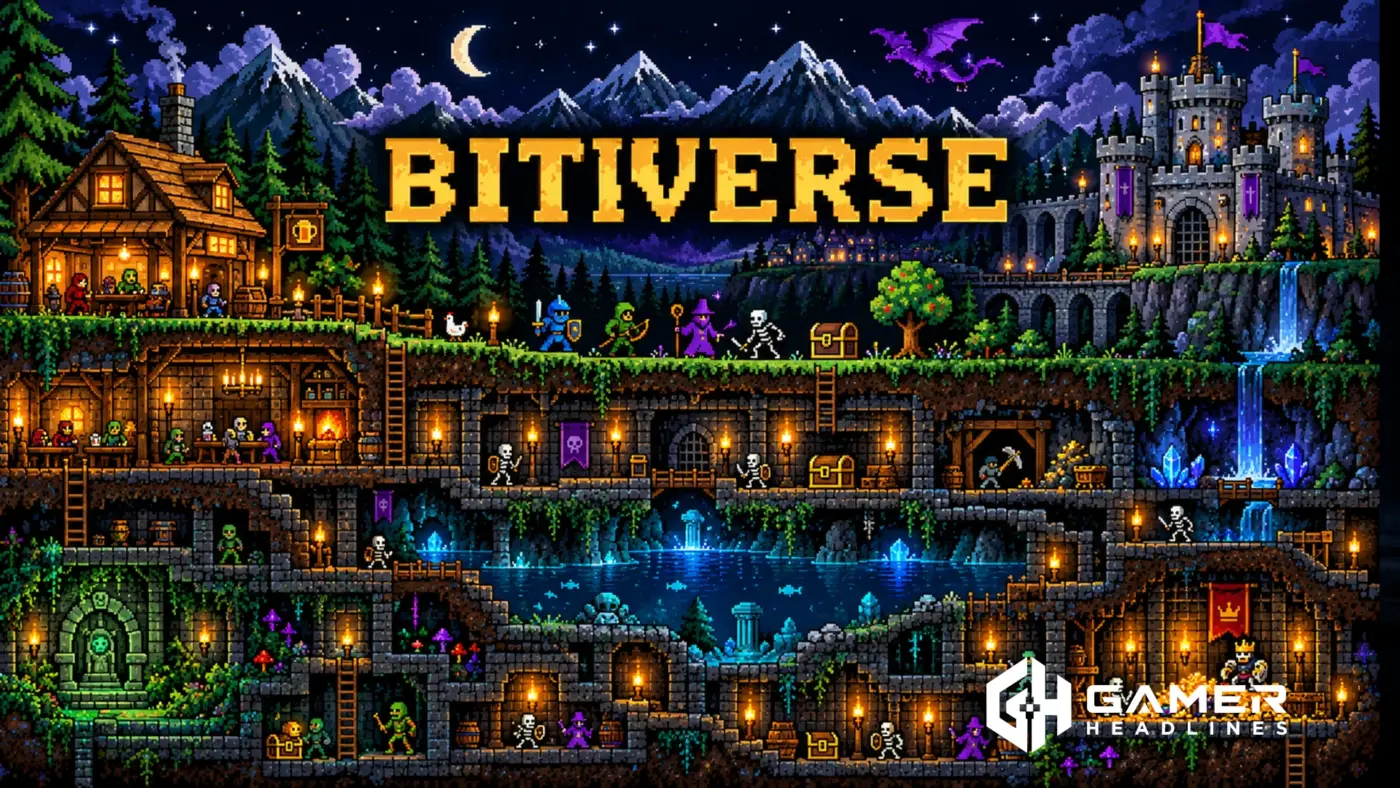
One developer has built a browser MMORPG with guild recall votes, player-written books and a weekly gazette. The machinery that makes emergent stories is all there. The population is the open question.
Bitiverse wears its Dwarf Fortress and EVE Online influences and ambitions on its sleeve. The interesting thing about Bitiverse is that the systems underneath it actually point that way, and you can check for yourself in about ninety seconds, because the whole game runs free in a browser tab with no download and no account.
It is 1-bit pixel art, and the studio’s own tagline is “Tiny pixels. Big world. Poor decisions.” One person builds it. It went up on itch.io on 15 July 2026 and has been updated most days since, with a Steam page opened on 25 September and no release date attached yet.
What You Actually Do
The familiar parts are all present. You fight monsters, train skills, mine, fish, farm, tame creatures and ride mounts, and work through seeded dungeons with bosses at the end. Crafting is the deep end, with more than 460 recipes spread across nine stations.
The less familiar parts are where the game spends its personality. You claim a homestead, name it, furnish it, add rooms and floors, and dig your own dungeon underneath it. You write books as real items, bind them, shelve them, and run off copies on a printing press. There are ten board and card games, chess and poker and dominoes among them. Long play leaves marks on your character in the form of ailments with names like Miner’s Cough and the Jitters, so a veteran miner is legible as one.
There are three civic houses, the Bonesetters, the High Ledger and the Verdant Circle, and rank inside them comes from what you do rather than how long you have been logged in. Trade runs through shops, market stalls, auctions and market boards.
The Gazette Is the Best Idea in Here
Once a week the game publishes a newspaper. Part of it writes itself from what happened on the server, reporting boss kills, sales at player shops by shop name, the contents of trade posts and errands falling due. The rest is written by players, and the front page is decided by what other players upvote.
This is a smarter piece of design than it first sounds. An MMO usually forgets what you did the moment you log out. A weekly paper turns the server’s activity into a record with an audience attached, which gives players a reason to do things that read well rather than only things that pay well. It also means a reputation can be built by someone who never touches a boss.
The gazette had a bug worth repeating. Until a patch on 23 September, headlines about boss fights named whichever player landed the last hit instead of the boss, which as the developer put it is a strange way to report a death.
Whether the EVE Comparison Holds
Stories of the kind Fortisq is invoking need three things. Players need real power over shared stuff, they need the ability to abuse it, and the world has to remember what happened. Bitiverse has made a serious attempt at all three.
Guilds run on councils. Any member can call a vote on a rule, a project, a spend or a seat, and a recall vote can hand the whole guild to whoever happened to be paying attention that day. That is a politics engine, and it is the same shape as the one that produces EVE’s famous betrayals, at a scale where a guild is a dozen people rather than ten thousand.
The abuse is already happening. Players worked out that a tamed eagle could fly over a rooftop and get past a padlocked door, which turned a mount into a lockpick. The 23 September patch made padlocks block flyers as well as walkers. That exchange, players finding a hole and a developer closing it, is the loop those games run on, and it is the strongest evidence that the comparison is not just marketing.
What Bitiverse does not have yet is people. Dwarf Fortress and EVE generate their stories out of scale and years of accumulated grudges. Bitiverse has nine ratings on itch.io and a Steam page with no date on it. The architecture is in place and the population is not, and no amount of good design fixes that from the developer’s side alone.
The Thing the Pitch Leaves Out
Fortisq’s own summary describes the usual MMO menu of fighting, taming, levelling and skills. It does not mention that Bitiverse has permadeath. Die and your character is gone, a gravestone marks the spot, and someone has to go and retrieve what is on it. The developer has thought about the edge cases, to the point that a collapsing dungeon now preserves the graves inside it.
That is not a criticism of the design. Permanent loss is exactly what makes the rest of it matter, because a guild vote and a newspaper headline mean more when the stakes are real. It is a criticism of the pitch. Permadeath is the single biggest thing separating this from the typical MMO experience the summary promises, and it belongs in the first line rather than halfway down a feature list.
Where to Start
Bitiverse is free and runs in a browser with nothing to install and no account to make, which removes every reason not to try it. There are also downloads for Windows at 85MB, a Linux AppImage at 121MB and an Android build at 639kB. It carries English, Italian, Spanish, Brazilian Portuguese, Simplified Chinese and Swedish. The Steam version is listed as coming soon, Windows only, free-to-play, with no date announced.
The honest summary is that a solo developer has built the skeleton of a game that generates its own stories, and has built it more thoughtfully than most funded studios manage. Whether it ever produces the tales Fortisq is reaching for depends on something the developer cannot ship, which is a few hundred people all deciding to live there at once. The browser build costs nothing, so being one of them is free.
The Facts
| Field | Detail |
|---|---|
| Developer and publisher | Fortisq Studio, solo developer |
| Launched | 15 July 2026 on itch.io, updated most days |
| Steam | Page opened 25 September 2026, coming soon, free-to-play |
| Price | Free on itch.io, Free on Steam (upcoming release) |
| Platforms | Browser, Windows (85MB), Linux AppImage (121MB), Android (639kB); Steam build Windows only |
| Account | Not required to play in browser |
| Languages | English, Italian, Spanish, Brazilian Portuguese, Simplified Chinese, Swedish |
| Community rating | 4.4 out of 5 from 9 ratings on itch.io |


