Ghost of Yotei Review: Sucker Punch’s PS5 Samurai Sequel Is a Beautifully Brutal Hit
Ghost of Yōtei review: 87 Metacritic, 3.3M copies sold, D.I.C.E. GOTY winner. Is it worth $70? Combat, story, PC status, Collector's Edition and verdict.
Our Score: 9 / 10
Ghost of Yotei is the standalone PS5 sequel to 2020’s Ghost of Tsushima that fans have been waiting for since Jin Sakai’s story ended. It scored 87 on Metacritic, sold over 3.3 million copies in its first 31 days, and won Adventure Game of the Year at the 29th D.I.C.E. Awards on February 12, 2026. If you own a PS5 and liked Ghost of Tsushima, stop reading and go buy it. If you want to know exactly why — and what its real limitations are — read on.
One thing to clear up immediately: Ghost of Yotei is currently PS5-exclusive and will likely stay that way. Bloomberg’s Jason Schreier reported in March 2026 that Sony cancelled the PC port that Nixxes had brought to an “extremely far along” state, as part of a broader retreat from releasing single-player AAA games on PC. More on that below.
What Is Ghost of Yotei?
Ghost of Yotei is a 2025 action-adventure game developed by Sucker Punch Productions — the Seattle studio behind Infamous: Second Son and Ghost of Tsushima — and published by Sony Interactive Entertainment. It is a standalone sequel set 329 years after the events of Ghost of Tsushima, in a completely different region of Japan with a new protagonist. No prior knowledge of the first game is required.
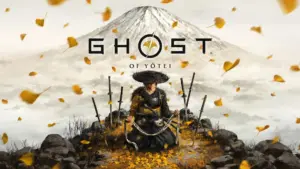
The game is set in 1603 Ezo — the wild, snow-covered northern frontier that is now Hokkaido — at the dawn of the Edo period, three years after the Battle of Sekigahara. This is the exact year Tokugawa Ieyasu was named shogun, and central authority had not yet reached Ezo. Displaced rōnin, Ainu communities, and rival clans fill the vacuum. It is a far rawer, more frontier-feeling world than Tsushima’s occupied island, and Sucker Punch makes excellent use of that contrast.
Many people search for “ghost of tsushima 2” expecting to find this game — and they’re essentially right. Ghost of Yōtei is Ghost of Tsushima 2 in every meaningful way, even if Sucker Punch deliberately avoided that subtitle.
Ghost of Yōtei Release Date and Platform
The Ghost of Yōtei release date was October 2, 2025, exclusively on PlayStation 5 and PlayStation 5 Pro. The game launched with PS5 Pro enhancements from day one and received a patch adding New Game+ in late November 2025. The free Ghost of Yōtei: Legends co-op mode followed on March 10, 2026.
If you are asking when does Ghost of Yōtei come out on PC — it doesn’t, and right now there is no indication it will. Sony cancelled the Nixxes-developed PC version as part of a strategy shift confirmed in March 2026. Ghost of Tsushima Director’s Cut came to PC in May 2024, but Yōtei appears to be a permanent PS5 exclusive for the foreseeable future.
Story: Atsu and the Yōtei Six
The story begins sixteen years before the game opens. On what survivors call the “Night of the Burning Tree,” a renegade samurai lord named Saitō and his band of outlaws — the Yōtei Six — slaughtered Atsu’s family at their ancestral home. Young Atsu was pinned to a sacred ginkgo tree with her father’s katana, the Wolf Blade, and left to burn. She survived, spent years fighting as a mercenary, and now returns to Ezo with a bloodied sash listing six names.
The player controls Atsu, voiced by Erika Ishii (English) and Fairouz Ai (Japanese). She is one of the strongest protagonists in recent PlayStation history — where Ghost of Tsushima’s Jin Sakai struggled with stoic honor and the shame of becoming the Ghost, Atsu never wavers. She knows exactly what she is and what she came to do. That moral clarity makes her more compelling in practice, even if it sacrifices some of Jin’s internal conflict.
The Yōtei Six are: the Snake, the Kitsune, the Oni, the Spider, the Dragon, and Lord Saitō himself. Each controls a distinct region of Ezo, commands themed enemy types, and functions as a standalone boss arc. Saitō has declared himself “Shogun of the North” and is consolidating rōnin under his banner to claim Ezo before the Matsumae clan — loyal to the new Tokugawa government — can pacify it. Atsu’s personal revenge quest keeps colliding with this larger political war, and with the indigenous Ainu people caught in the middle.
The supporting cast — Hanbei the one-armed dual-katana master, Atsu’s surviving brother Jubei (now Lord Kitamori, a Matsumae officer), Oyuki, Kiku, and the wolf companion — gives the revenge framework real human stakes. The story is predictable in its broad strokes but deeply satisfying in its execution. IGN’s Michael Higham called it “a predictable but well-executed story” that works because of “a strong lead in Atsu as a vigilante who does not care about honor in her quest for revenge.”
When Does Ghost of Yōtei Take Place — and Why It Matters
Ghost of Yōtei takes place in 1603, at the dawn of the Edo period, specifically in Ezo (modern-day Hokkaido). This is 329 years after Ghost of Tsushima’s 1274 Mongol invasion setting, which is why the two games feel so tonally different despite sharing mechanics and a studio.
The 1603 setting is carefully chosen. The Tokugawa shogunate has just been established, but its authority barely reaches Ezo. The island is genuinely ungoverned frontier territory — a Japanese Wild West — where Ainu clans, Matsumae lords, and Saitō’s rogue army fight for dominance. Sucker Punch collaborated with Ainu cultural consultants throughout development, resulting in one of gaming’s most careful depictions of an indigenous people. Famitsu’s 38/40 panel specifically praised the portrayal.
How Many Chapters Are in Ghost of Yōtei?
Ghost of Yōtei is structured into three main acts bookended by a prologue (killing the Snake as a tutorial) and a climactic finale duel with Lord Saitō. Most players and guides refer to these as “chapters,” though the game itself labels them as acts. Across the three acts there are approximately 10 main story missions — the three long act-defining hunts for the Oni, Kitsune, and the Saitō Brothers (Spider and Dragon), plus shorter connective quests.
Crucially, you can hunt the Yōtei Six in any order — except for the Snake (always first) and Saitō (always last). It is a deliberately non-linear structure inspired by Shadow of the Colossus and Kill Bill. The game leans into the cinematic reference hard: Atsu’s sash-list is visually lifted straight from Kill Bill’s death list, and the chapter-hunt structure maps directly onto Tarantino’s revenge arc. Whether you find that homage charming or derivative depends on your appetite for influence.
How Long Is Ghost of Yōtei?
How long is Ghost of Yōtei varies considerably by playstyle:
- Critical path (Casual or Medium difficulty): 20–25 hours
- Balanced playthrough (story + selected side missions): 30–45 hours
- Heavy completionist run: 50–65 hours
- Platinum trophy / full 100%: 65–80+ hours
- Hard or Lethal difficulty: add roughly 10–15 hours on any route above
This makes Ghost of Yōtei one of the more disciplined open-world games in Sony’s recent portfolio. It is roughly on par with Ghost of Tsushima rather than inflated like some contemporaries. A New Game+ mode was added in a free patch in late November 2025, allowing replays of Challenge Missions and Duels with carried-over progression.
Combat: Five Weapons, One Wolf, No Stances
This is where Ghost of Yōtei makes its boldest break from its predecessor. Creative director Nate Fox confirmed that the four-stance katana system from Ghost of Tsushima has been scrapped entirely. In its place is a five-weapon system — each weapon unlocked through a dedicated weapons master and tuned to specific enemy types:
- Katana — Atsu’s starting weapon, versatile and balanced, strongest against swordsmen
- Dual katana — unlocked through a memorable arc with Hanbei; brilliant for crowd control
- Ōdachi — two-handed greatsword built to break heavily armored brutes
- Yari (spear) — long reach, launches enemies, dominates dual-wielders
- Kusarigama — chain-sickle; hooks shield-bearers and yanks them off balance; the most unique tool in the kit
Each weapon has a deep upgrade tree and its own parry timing. Add to that two bow types (hankyu and yumi) and historically accurate matchlock firearms — the tanegashima rifle and tanzutsu pistol — and Ghost of Yōtei has the most varied combat sandbox Sucker Punch has ever built.
New in combat: disarming attacks work both ways — Atsu can disarm enemies, and enemies with the right skills can disarm her. You can snatch a fallen enemy’s blade mid-fight and throw it back. Atsu can also whistle for her wolf companion, who joins her in both open combat and stealth sequences.
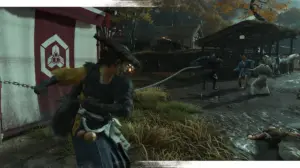
The verdict on combat is almost uniformly excellent. XDA Developers called it “the best combat ever seen in a samurai game.” The one significant criticism comes from Gideon’s Gaming, which flags that the weapon-counter system on Hard or Lethal difficulty becomes “very rock-paper-scissors” — clunky to switch weapons mid-fight while managing the stagger bonuses from correct match-ups. It is the game’s most legitimate design complaint, and it is more noticeable the harder you play.
Stealth and Open World Exploration
Stealth returns as a full pillar of gameplay — Ghost of Yōtei is not action-only. Enemies no longer share a psychic alarm: clearing one section of an outpost doesn’t always alert the entire camp. Standoff and showdown openings carry over from Tsushima, letting you open fights with quick-time chain kills before formal combat begins.
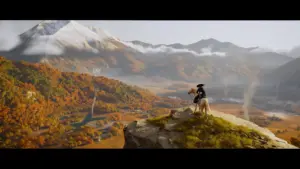
The open world is denser than Ghost of Tsushima’s rather than larger, organized into distinct biomes: the Yōtei Grasslands, the Ishikari Plain, the Tokachi Range, and the Oshima Coast. Each has its own weather patterns, color palette, faction politics, and seasonal cosmetics. Dynamic weather — drawing from the real climate around Hokkaido’s Mount Yōtei — brings snow, heavy rain, and full aurora borealis displays, all of which interact with combat visibility and enemy detection.
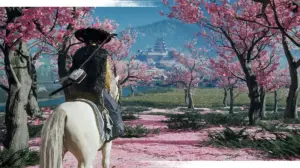
Side activities are where Sucker Punch’s polish really earns its keep:
- Sumi-e painting replaces haiku composition, with players tracing brushstrokes via the DualSense touchpad. For anyone who’s owned a PS5 since launch and tracked the evolution of DualSense features, this is one of the more creative uses of the controller’s haptics in a first-party title.
- Zeni hajiki — an in-game coin-flicking gambling game, also included physically in the Collector’s Edition
- Shamisen songs alter the direction of the guiding wind mechanic
- Hot springs (onsen) for permanent health upgrades
- Bamboo strikes for spirit/resolve upgrades
- Fox dens and wolf dens for charm and skill rewards
- Altars of Reflection — new story-based meditative interludes
- Bounty hunts — a major new pillar; paid contracts across Ezo
- Weapon mastery quests — unlock new techniques from each weapons master
- Atsu’s camp — cook for stat boosts, craft ammo, trade with vendors
The Wolf Pack — Atsu’s gradually-recruited band of side characters — connects side missions to the main narrative more cohesively than Tsushima managed. Most reviewers agree: side quests feel like story content, not filler.
Three visual modes are available: Kurosawa Mode (black-and-white, film-grain) returns from Tsushima, joined by Miike Mode (grindhouse-bloody, inspired by Takashi Miike) and Watanabe Mode (lo-fi cinematic aesthetic inspired by Shinichirō Watanabe of Cowboy Bebop). All three are free and available from launch.
Ghost of Yōtei PS5 Performance: Which Mode to Choose
Ghost of Yōtei PS5 and PS5 Pro both support four distinct graphics modes — one of the most granular options menus Sucker Punch has offered:
- Quality Mode — 4K upscaled from 1440p on base PS5, locked 30fps. Sharpest image, best for screenshots and photo mode.
- Performance Mode — Dynamic 1440p (upscaled from 1080p on base PS5), 60fps. The recommended mode on standard PS5 hardware.
- Ray Tracing Mode — Ray-traced shadows and global illumination at 30fps. First RT implementation in Sucker Punch history. Available on both PS5 and PS5 Pro.
- Ray Tracing Pro Mode — PS5 Pro exclusive. RT at 60fps via PSSR (PlayStation Spectral Super Resolution) upscaling. Universally considered the definitive way to play.
VRR is supported, HDR10 is implemented with per-scene tone mapping, and the DualSense haptics map to katana strikes, parries, weapon weight, and stamina state. Push Square called it “the best use of haptic feedback since Returnal.”
If you have a standard PS5, play on Performance Mode. If you have a PS5 Pro, Ray Tracing Pro is the mode this game was built for. The generational difference in image quality between standard PS5 Quality Mode and PS5 Pro Ray Tracing Pro Mode is genuinely striking — one of the clearer arguments for the Pro hardware to date. For a deeper look at how PS5 hardware differences affect first-party game quality, our PS5 vs PS4 performance breakdown covers the generational gap in detail.
Will Ghost of Yōtei Be on PC?
No — not currently, and not in the foreseeable future.
Ghost of Tsushima Director’s Cut launched on PC on May 16, 2024 via Nixxes Software, and every signal pointed to Ghost of Yōtei following the same path. Nixxes had reportedly brought a PC port to an “extremely far along” state, with a Q2 2026 target.
Then, on March 4, 2026, Bloomberg reported that Sony cancelled the port as part of a broader pullback from releasing single-player AAA titles on PC. PlayStation Studios CEO Hermen Hulst confirmed the policy shift to staff in a May 2026 town hall. Sony will continue releasing multiplayer and live-service titles (Marathon, Marvel Tōkon: Fighting Souls) on PC, but Ghost of Yōtei joins the category of PS5-exclusive single-player games Sony is no longer porting.
This is directly connected to the broader question of Sony’s first-party strategy and its willingness to leverage exclusivity as a PS5 hardware driver, particularly after the costly lessons of the Bungie acquisition. The short version: if you want to play Ghost of Yōtei, you need a PS5. That is unlikely to change.
Ghost of Yōtei Collector’s Edition: What You Get
The Ghost of Yōtei Collector’s Edition is priced at $249.99 / £219.99 and is a PS Direct exclusive. It contains:
- Digital download code for Ghost of Yōtei (no physical disc)
- Full Digital Deluxe in-game contents: armor set, armor dye, horse and saddle, sword kit, charm, early Traveler’s Maps
- A 6.8″ resin Ghost mask (Atsu’s mask) with display stand
- A 3″ cast-metal tsuba (sword guard) with display stand
- A 71-inch cotton-blend sash hand-printed with the names of the Yōtei Six
- A papercraft ginkgo tree referencing the Night of the Burning Tree
- Four 5×7 art cards
- A pouch of real zeni hajiki coins for the in-game minigame
You can order it directly from the PlayStation Direct Collector’s Edition page.

The controversy: there is no physical disc. For $250 you receive a download code in a high-quality wooden box. The physical pieces are genuinely well-made — the mask in particular is display-worthy — but the disc-less Collector’s Edition has frustrated physical-media collectors across the industry. Consider yourself warned before ordering.
Two limited-edition PS5 console bundles also launched alongside the game: the globally-available Gold Kintsugi PS5 and the PS Direct-exclusive Sumi-e Ink Brush PS5, plus a Ghost of Yōtei DualSense controller. The Standard Edition ($69.99) and Digital Deluxe ($79.99) round out the lineup.
Ghost of Yōtei: Legends (Free Co-op Mode)
The base game is single-player only. But on March 10, 2026, Sucker Punch released Ghost of Yōtei: Legends as a free update — a successor to Ghost of Tsushima’s surprisingly popular Legends co-op mode.
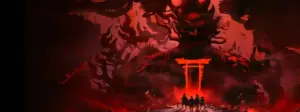
Legends features two-player story missions based on Japanese mythology, a four-player survival/horde mode against supernatural versions of the Yōtei Six, and four distinct player classes with separate gear progression. Early critic scores are positive: 86 from Game8, 85 from Uagna.it, and 80 from GamingBolt. The main criticism is that it iterates on Tsushima’s Legends rather than reinventing it. As a free post-launch addition, though, it is solid value for existing owners.
Critical Reception: What the Reviews Say
Ghost of Yōtei holds an 87 on Metacritic from 102+ critics and an 89 on OpenCritic with 94% recommending it — earning the “Mighty” badge that fewer than 2% of all games receive. It scored 38/40 from Famitsu (9/10/10/9) — the highest Famitsu score in Sucker Punch’s history.
A representative spread of verdicts:
IGN — 9/10 (Michael Higham, Sept. 25, 2025): A gorgeous, satisfying open-world samurai game with “a strong lead in Atsu” and “an expanded weapon-set that elevates the gameplay principles set by Tsushima.”
Famitsu — 38/40: Highest Sucker Punch score ever from the Japanese panel, with specific praise for the respectful portrayal of Ainu culture.
XDA Developers: Called the combat “the best ever seen in a samurai game.”
Push Square: “An instant classic and brilliant from start to finish.” Also called the DualSense haptics “the best since Returnal.”
The Punished Backlog (Sam Martinelli, Oct. 15, 2025): “Despite my sincere enjoyment of Ghost of Yōtei, I genuinely hope it’s the last of its kind, at least for a while” — a constructive critique of open-world genre fatigue rather than the game itself.
Gideon’s Gaming: “A perfectly adequate sequel experience” with a weapon-counter system that is “very gamey and arbitrary” on higher difficulty settings.
Digitally Downloaded (Matt Sainsbury): The strongest dissenting voice, arguing the game’s portrayal of Ainu culture is “revoltingly patronising” and treats Ezo as “an all-American Wild West story” in Japanese clothes.
The game won Adventure Game of the Year at the 29th Annual D.I.C.E. Awards on February 12, 2026, plus Outstanding Achievement in Character (Atsu / Erika Ishii) and Outstanding Achievement in Original Music Composition. It was nominated for eight D.I.C.E. awards — tied with Clair Obscur: Expedition 33 for most-nominated — but lost Game of the Year to Clair Obscur.
Controversy and Community Reception
Two controversies surrounded Ghost of Yōtei’s launch window:
The Drew Harrison incident (September 2025): A Sucker Punch developer posted a politically charged joke on Bluesky that went viral. Co-founder Brian Fleming condemned it, Sony confirmed Harrison had left the studio, and the incident triggered coordinated review-bombing threats in the weeks before release.
The female protagonist backlash: A subset of online critics objected to a female lead and to Erika Ishii’s social media history, generating further review-bombing. The result is visible on Metacritic: the critic average of 87 contrasts sharply with deflated user scores driven by bad-faith submissions.
Community reception among actual players has been overwhelmingly positive. r/ghostofyotei and r/PS5 treated the game as an automatic Game of the Year contender on launch. The most common real complaint from engaged players — as opposed to review-bombers — is that the structure is “Ghost of Tsushima but more polished,” which reads differently depending on how you feel about the formula.
Ghost of Yōtei vs Ghost of Tsushima: Which Is Better?
This is the question every “ghost of tsushima 2” search eventually lands on. The honest answer is: Ghost of Yōtei is the better game in almost every measurable category, but Ghost of Tsushima may remain the more memorable experience for many players.
Ghost of Yōtei does these things better:
- More weapon variety and greater combat depth
- Denser, more varied open world with genuine biome identity
- Stronger protagonist — most reviewers prefer Atsu’s clarity to Jin’s stoicism
- Better side content with genuine narrative payoff
- More polished PS5-native visuals, dynamic weather, ray tracing
- Modern quality-of-life systems baked in from launch
Ghost of Tsushima still has these advantages:
- The novelty of the 2020 debut — nothing beats a first impression
- A sharper internal moral conflict (honor vs. the Ghost)
- The Iki Island expansion remains exceptional standalone content
- Already on PC for those without a PS5
If you have never played either game and own a PS5, start with Ghost of Yōtei — it is the more refined entry point and requires no prior context from Tsushima. If you already played and loved Tsushima, Ghost of Yōtei is exactly what you want from a sequel: familiar at its core, better in almost every detail.
Ghost of Yōtei Review Verdict: Is It Worth Buying?
Yes — for anyone with a PS5 or PS5 Pro who enjoys cinematic action-adventure games, Ghost of Yōtei is one of the cleanest recommendations on the platform. It sold 3.3 million copies in 31 days, won D.I.C.E. Adventure Game of the Year, and delivers exactly what it promises: a gorgeous, mechanically satisfying open-world samurai game with a compelling lead and a world worth exploring for 40–60 hours.
The caveats are real but manageable. The weapon-counter system on high difficulty settings feels gamey rather than organic. The Yōtei Six structure is less non-linear than the marketing implied. The Collector’s Edition, at $249.99 with no disc, is steep for what is ultimately a download code in a box. And the PC port is cancelled — Sucker Punch’s PlayStation-first strategy, familiar to anyone watching Sony’s broader moves, means Ghost of Yōtei is a PS5 purchase or nothing.
None of those caveats outweigh what Ghost of Yōtei gets right. For PS5 owners, this is a straightforward buy. Pick up the Standard Edition at PlayStation and go in unspoiled.
For more PlayStation coverage, check out our PlayStation section and our full reviews archive.
Ghost of Yōtei FAQ
What is Ghost of Yōtei? A standalone PS5 action-adventure sequel to Ghost of Tsushima, set in 1603 Ezo (Hokkaido) with a new protagonist, Atsu.
When did Ghost of Yōtei come out? October 2, 2025, exclusively on PlayStation 5.
Will Ghost of Yōtei be on PC? No. Sony cancelled the PC port in early 2026 per Bloomberg reporting. No PC release is currently planned.
How long is Ghost of Yōtei? Around 20–25 hours for the main story, 30–45 hours for a balanced playthrough, and 65–80+ hours for the Platinum trophy.
How many chapters does Ghost of Yōtei have? Three main acts plus a prologue and finale, totaling approximately 10 main story missions.
What is the Ghost of Yōtei Metacritic score? 87 from 102+ critics. 89 on OpenCritic with 94% recommending.
Does Ghost of Yōtei have multiplayer? Yes — Ghost of Yōtei: Legends, a free 1–4 player co-op mode, launched on March 10, 2026.
What comes in the Ghost of Yōtei Collector’s Edition? A $249.99 PS Direct exclusive with a Ghost mask, tsuba, sash, papercraft ginkgo tree, art cards, zeni hajiki coins, and a Digital Deluxe code — but no physical disc.
Is Ghost of Yōtei better than Ghost of Tsushima? By most measurable metrics, yes. Better combat, stronger protagonist, denser world, and better side content. But many players still hold the original’s novelty factor above the sequel’s refinement.
Do I need to play Ghost of Tsushima before Ghost of Yōtei? No. Ghost of Yōtei is a standalone sequel with no shared characters or required story context.
THE VERDICT
Ghost of Yotei is one of the cleanest recommendations on PS5 — a gorgeous, mechanically satisfying open-world samurai game with a compelling lead and a world worth exploring for 40–60 hours.
THE HIGHS
- Superb five-weapon combat — the best in a samurai game
- Compelling protagonist Atsu and a well-told revenge story
- Dense, biome-rich open world with dynamic weather
- Outstanding DualSense haptics and PS5 Pro ray tracing
THE LOWS
- Weapon-counter system feels gamey on higher difficulties
- No PC release — the port was cancelled
- Yōtei Six structure is more linear than marketed