

The Legend of Zelda: Tears of the Kingdom Review — Nintendo’s Masterpiece, Three Years Later
Three years after its release, The Legend of Zelda: Tears of the Kingdom still sits at a 96 on Metacritic and a 95 on OpenCritic, where 97% of critics recommend it. Those numbers don’t move much. What has changed is the conversation around the game — the initial flood of perfect scores has settled into something more considered, and the question now isn’t “is it good?” but “is it actually better than Breath of the Wild, and is it still worth picking up in 2026?” Both answers are yes.
What Is The Legend of Zelda: Tears of the Kingdom?
The Legend of Zelda: Tears of the Kingdom (TotK) is a 2023 open-world action-adventure game developed by Nintendo EPD and published by Nintendo for the Switch. It is the 20th mainline entry in the Zelda franchise and a direct sequel to 2017’s Breath of the Wild — a structural rarity for a series that historically starts fresh with each installment. Directed by Hidemaro Fujibayashi and produced by longtime Zelda steward Eiji Aonuma, it launched worldwide on May 12, 2023 at a US$70 price point — Nintendo’s first internally developed game at that price. An enhanced Nintendo Switch 2 Edition followed on June 5, 2025, adding higher resolution, an improved frame-rate cap, HDR support, faster load times and integration with the ZELDA NOTES companion feature.
If you want the short version: this is a rare game where the critical consensus and the commercial result agree with each other completely. It sold over 10 million copies in its first three days — the fastest-selling Zelda ever — and has reached 22.4 million lifetime sales as of December 2025, making it the eighth best-selling Nintendo Switch game of all time.
For a deeper look at where TotK fits among the best games on Nintendo’s platform, our best Nintendo Switch games guide puts it in full context.
Story: A Real Sequel, Not Just More Hyrule
Tears of the Kingdom picks up some years after Breath of the Wild. Link and Princess Zelda are exploring a cavern beneath Hyrule Castle when they discover ancient murals, a poisonous substance called “gloom,” and a desiccated mummy restrained by a mysterious disembodied arm. The mummy — Ganondorf — awakens, shatters the Master Sword, wounds Link’s arm, and lifts Hyrule Castle into the sky. Zelda vanishes into the depths below. Link is rescued by the spirit of Rauru, an ancient Zonai king, who gives him a new mysterious arm as a replacement.
This opening event, the “Upheaval,” sets the entire game in motion. Sky islands appear above Hyrule, chasms tear open in the earth below, and gloom spreads across the land. Link’s quest has two interlocking threads: follow sightings of Zelda by collecting “Dragon’s Tears” memories scattered across Hyrule, and fight through the four regional crises Ganondorf has engineered to claim the kingdom. The story is far more present and emotionally ambitious than Breath of the Wild’s, with a genuine payoff that most players and critics found unexpectedly moving. It can still be experienced largely in any order — this is an open-world Zelda, not a linear one — but the narrative has real momentum in a way BotW’s memory-fragment structure never quite achieved.
Setting: A Familiar Map, Made New
TotK reuses the same surface map as Breath of the Wild, which is either its cleverest move or its most frustrating depending on your perspective. The geography has been meaningfully reshaped — the Upheaval has altered terrain, destroyed some areas and created new ones, and Hyrule Castle now floats dramatically above the central field — but returning players will recognize where they are throughout. The novelty comes from two entirely new vertical layers.
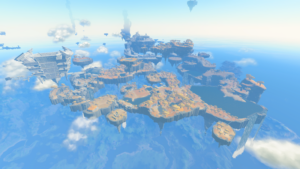
The Sky is a network of floating islands ranging from tiny puzzle platforms to large inhabited complexes, reached by launching from geysers or building flying machines. It holds shrines, treasure, and bosses, and rewards patient aerial exploration.
The Depths is the bigger addition: a vast, pitch-black underground region that roughly mirrors the surface map in size, bringing TotK’s total explorable area to more than double Breath of the Wild’s. It is hostile territory — Brightbloom seeds and Lightroots provide the only illumination, gloom chips away at Link’s maximum hearts, and the oppressive atmosphere makes the surface feel comforting by contrast. It also holds the game’s most valuable rare materials and some of its best secrets.
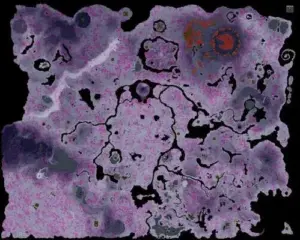
The three-layer structure means that the Depths, the Surface and the Sky regularly interconnect: you can dive from a sky island, plummet through a surface chasm, and emerge somewhere entirely new. That vertical continuity is one of TotK’s defining design achievements, and it is something that genuinely could not have been built on older hardware.
The New Abilities: Ultrahand, Fuse, Ascend, Recall
BotW’s Sheikah Slate runes are gone. In their place TotK gives Link five new powers through his Zonai arm, and they fundamentally change how every problem in the game is approached.
Ultrahand lets Link grab, move, and attach objects together. Combine it with Zonai devices — fans, wheels, rockets, flame emitters, batteries, cannons, springs, and more — and it becomes a full-blown vehicle and construction system. Players have built working tanks, biplanes, hot air balloons, and elaborate automated traps. This is the headline mechanic, and it spawned an entire ecosystem of shared creations that kept the community active for years after launch.
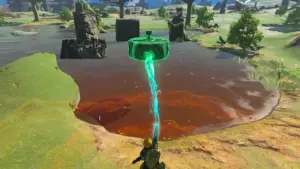
Fuse lets Link bond materials, weapons, and objects together to create stronger, stranger weapons. Attach a boulder to a stick and you have a hammer. Attach a rocket to a shield and you can launch yourself into the sky. Fuse is also Nintendo’s answer to weapon durability: instead of just losing a weapon when it breaks, you can fuse new parts onto it continuously, creating chains of improvised upgrades that make the system feel generative rather than punishing.
Ascend lets Link swim upward through any solid ceiling, emerging on the surface above. It is the single most elegant traversal tool in the game — instantly enabling shortcuts through caves, dungeons and mountain faces that would otherwise require climbing.
Recall rewinds the movement of a single object. Use it on a falling rock to ride it back up to a sky island. Use it on a moving platform to reverse its path. It sounds simple and becomes genuinely deep in puzzle and combat contexts.
Autobuild (unlocked mid-game) instantly recreates previously built Ultrahand designs, spending a resource called zonaite to fabricate any missing parts. It effectively gives you a saved library of your own engineering work.
Together these abilities turn Hyrule into a physics playground. As OpenCritic’s critic consensus put it: “Nearly every encounter, whether puzzle, traversal, or combat, must be reconsidered. It makes you think in new ways.”
Combat: Expanded, More Dangerous
Combat builds on BotW’s foundations — Flurry Rush dodges, shield parries, and elemental interactions all return — but TotK is more dangerous and more varied. The Fuse system means your loadout is defined by what you build rather than what you find, and managing materials becomes a minor meta-game of its own.
The enemy roster is meaningfully larger than Breath of the Wild’s and considerably more interesting. New threats include Gloom Hands — a fast, multi-fingered horror that punishes players with permanent heart loss and spawns a Phantom Ganon variant if defeated — and three new elite enemy types: the multi-headed elemental Gleeoks, the shape-shifting geometric Flux Constructs, and the enormous underground Frox. Returning enemies like Lynels are not going anywhere. And the climactic multi-phase Ganondorf encounter is widely considered the best final boss in the series — something critics and players agree on with unusual unanimity.
Shrines, Dungeons and Structure
TotK has 152 Shrines across the Surface (120) and Sky (32), up from Breath of the Wild’s 120. Each yields a Light of Blessing: four exchange for a heart container or stamina upgrade at a Goddess Statue, and clearing all 152 unlocks the Ancient Hero’s Aspect armor set. In the Depths, 120 Lightroots mirror the surface shrines for fast travel and illumination, bringing the total shrine-and-lightroot count to 272 objectives — a substantial increase in structured content.
More importantly, TotK addresses what was the most consistent criticism of Breath of the Wild: the Divine Beasts were interesting but felt like disconnected floating puzzles rather than proper dungeons. The four main temples in TotK — Wind, Fire, Water and Lightning — each have a distinct regional theme and aesthetic, require you to understand their structure to progress, feature a named sage companion with a unique ability, and end with a proper boss fight. They’re not as sprawling as classic Zelda dungeons, but they’re a genuine step forward, and they restore some of the sense that the world’s major threats must be engaged directly rather than merely cleared.
Performance on Nintendo Switch
TotK targets 30fps and achieves it most of the time. After a day-one patch, Digital Foundry’s analysis reported the game “holds very closely to the 30fps target” across most scenarios, with notable drops occurring primarily when first activating Ultrahand in physics-heavy builds, and in densely populated areas like Kakariko Village. Frame-rate analysis showed most drops settling around 20fps briefly rather than sustained degradation.
SkillUp called the performance “a technological miracle” for what the hardware achieves. The 30fps ceiling remains the game’s most consistent critical complaint. The file size is 16.3 GB — up from Breath of the Wild’s 14.4 GB — which matters if you’re managing Switch storage. If that’s a concern, our guide to the best SD cards for Nintendo Switch covers the options.
The Nintendo Switch 2 Edition improves the experience meaningfully: higher resolution via a better upscaling pipeline, improved frame-rate cap, HDR support, and faster load times make it the definitive way to play if you have the hardware. On the original Switch, the game is still excellent — just accept the 30fps ceiling and occasional dips.
Music and Sound Design
TotK builds on Breath of the Wild’s sparse, piano-led ambient score but is more confident and varied. The Sky islands lean on breathy woodwinds and saxophone. The Surface retains the region-by-region ambient evolution of BotW. The Depths abandon melody almost entirely for dissonant, industrial drone — effective in creating dread. Dynamic battle music strips down and swells in response to combat state in a way that becomes genuinely exciting at higher difficulty levels.
The full original soundtrack — composed by Manaka Kataoka, Maasa Miyoshi, Masato Ohashi and Tsukasa Usui — was released physically in Japan by Nippon Columbia on July 31, 2024 (a nine-disc set, 344 tracks, approximately 11 hours of music) and made available for worldwide streaming through the Nintendo Music app from June 3, 2025. Critics broadly praised it, with particular attention paid to the emotional use of Zelda’s recurring leitmotif in the story’s closing sequences.
How Long Is Tears of the Kingdom?
Based on HowLongToBeat community data:
- Main story only: ~59 hours
- Main story + side content: ~109 hours
- Full 100% completion: ~224 hours
VideoGamer puts the story closer to 50–70 hours depending on difficulty and how much side content you pick up naturally. A Korok-seed completionist run (all 1,000 seeds) adds dozens of hours on top of that. There is no post-game in the conventional sense — the world continues after the credits with remaining objectives intact.
Replayability is primarily driven by Ultrahand’s creative potential, which remains fresh across multiple playthroughs because players invent new approaches rather than following a fixed solution set.
Tears of the Kingdom vs Breath of the Wild: Which Is Better?
The critical consensus is clear: Tears of the Kingdom is the better game. IGN’s Tom Marks called it a game that improves on Breath of the Wild “in nearly every way.” GameSpot’s Steve Watts gave it a 10/10. Game Informer’s Kyle Hilliard scored it 9.8/10.
The only consistent argument for Breath of the Wild is novelty. Returning players know this Hyrule already — the Surface is familiar, and the first-discovery wonder of BotW’s debut is unrepeatable. Game Informer captured it well: he “didn’t get the same goosebumps exploring Hyrule as I did in the past,” even while he “adored returning with all new tools.” If you never played BotW, that comparison is irrelevant — TotK is simply the richer, more feature-complete experience.
TotK has proper dungeons. TotK has a real story. TotK has a combat toolkit and enemy roster that holds up across its full 100+ hours. On nearly every axis where players criticized Breath of the Wild, TotK delivers a direct improvement. The Depths and the Sky add genuine new territory. The Sage abilities and temples restore some classic Zelda structure without removing the open-world freedom.
Our verdict: Tears of the Kingdom is the better game and the better starting point for anyone new to this era of Zelda. For those who adored BotW, it will not recreate that first feeling — nothing could — but it builds on it substantially.
What Critics Said: The Legend of Zelda: Tears of the Kingdom Reviews
The game holds a 96/100 on Metacritic and a 95 on OpenCritic, where it earned the “Mighty” badge reserved for the top tier of all reviewed games. At launch it briefly registered as the highest-rated game in OpenCritic’s history. A representative selection of reviews:
IGN — 10/10 (Tom Marks): “An unfathomable follow-up to one of the greatest games ever made, somehow improving upon it in nearly every way.”
GameSpot — 10/10 (Steve Watts): “Zelda: Tears of the Kingdom is a canvas for your own creativity, a book to write your own stories, a world to create your own legends.”
Game Informer — 9.8/10 (Kyle Hilliard): “They say you can never go home again, but I adored returning to Hyrule with all new tools.”
Eurogamer — 4/5 (Edwin Evans-Thirlwell): “A terrific Breath of the Wild follow-up with some brilliant new systems, amazing views and more dungeon-type spaces.” The “5” critique: “a slightly deadening emphasis on gathering resources.”
The lone strong dissenter was Gfinity’s Josh Brown, whose 6/10 review drew considerable community backlash — and sparked a healthy conversation about whether unanimous praise at launch ever serves players well. His core criticism was that TotK is iterative rather than transformative. It’s a fair point. It doesn’t change the outcome.
Any DLC or Post-Launch Content?
Unlike Breath of the Wild, which received two paid story DLC packs, Tears of the Kingdom has not had paid downloadable content. Aonuma indicated in post-launch interviews that the team felt it had built everything it intended into the base game and was not planning a direct sequel set in the same world. The game received free patches improving performance and fixing exploits, and the paid Nintendo Switch 2 Edition upgrade (June 5, 2025) is the major post-launch addition. A spin-off, Hyrule Warriors: Age of Imprisonment, released November 6, 2025 exclusively for Nintendo Switch 2, expanding the TotK-era story in a different direction.
Looking ahead, fans have begun discussing what form the next mainline Zelda will take — and the recent June 2026 Nintendo announcement of an Ocarina of Time remake for Nintendo Switch 2 suggests the company is actively revisiting the franchise’s past while TotK’s creative team presumably works on whatever comes next.
Should You Buy Tears of the Kingdom in 2026?
Yes — without reservation, if you own a Nintendo Switch or Switch 2. At this point in its lifecycle, TotK has a stable price, all post-launch patches applied, and a guide ecosystem mature enough to answer any question you’ll encounter. The creative ceiling of Ultrahand has barely been reached by the community, let alone exhausted by any individual player.
If you have not yet played either open-world Zelda: start here. If you played and loved Breath of the Wild: this is the version that addresses almost every criticism of that game, at the cost of some novelty. If the 30fps frame rate on original Switch hardware concerns you: the Switch 2 Edition removes that as a significant issue.
The only honest argument for skipping it is if weapon durability is an absolute dealbreaker — the mechanic returns, though Fuse transforms how you interact with it — or if you specifically want the tighter, dungeon-linear Zelda experience rather than a vast physics sandbox. For everyone else, this is the best game on Nintendo’s platform and one of the best of its decade.
See our best Nintendo Switch exclusives list and our full reviews archive for what else is worth your time on Nintendo hardware.
The Legend of Zelda: Tears of the Kingdom FAQ
What is the Metacritic score for Tears of the Kingdom? 96/100 on Metacritic and 95 on OpenCritic, where 97% of critics recommend it.
Is Tears of the Kingdom better than Breath of the Wild? Yes, by most measures — proper dungeons, a stronger story, expanded enemy variety, and double the explorable space. The only thing BotW has that TotK cannot replicate is the novelty of its own debut.
How long does it take to beat Tears of the Kingdom? Around 50–70 hours for the main story, ~109 hours for a balanced playthrough, and ~224 hours for 100% completion.
Does Tears of the Kingdom have DLC? No paid story DLC. The Nintendo Switch 2 Edition (June 2025) is a hardware-specific upgrade, not new content.
Is there a Tears of the Kingdom PC version? No official PC release. The game is Nintendo Switch and Nintendo Switch 2 exclusive.
Do I need to play Breath of the Wild first? No — TotK is a standalone experience. Playing BotW first adds emotional context for the returning world, but nothing in TotK requires prior Zelda knowledge.
How many shrines are in Tears of the Kingdom? 152 shrines: 120 on the Surface and 32 in the Sky. There are also 120 Lightroots in the Depths for fast travel, for a total of 272 objectives.
Is it worth buying on original Switch vs Switch 2? It is excellent on original Switch after its performance patch. The Switch 2 Edition runs at better resolution and frame rate, so if you have the hardware, that is the better version.
THE VERDICT
Tears of the Kingdom is the better game and the better starting point for anyone new to this era of Zelda. For those who adored Breath of the Wild, it won't recreate that first feeling — but it builds on it substantially.
THE HIGHS
- Revolutionary Ultrahand and Fuse physics systems
- Genuine themed dungeons — a direct fix for Breath of the Wild's biggest weakness
- The Depths and Sky nearly double the explorable world
- A real, emotionally ambitious story with a memorable payoff
THE LOWS
- 30fps ceiling with occasional dips on original Switch
- Reused surface map softens the sense of first discovery
- Weapon durability persists and may still deter some players


